

If you’ve been playing tennis for a year or two and feel ready to move beyond your first racket, you’re probably wondering which intermediate model will best support your developing game. The jump from beginner to intermediate equipment can feel like a big step, but choosing the right racket at this stage is crucial for continued improvement.
After years of helping players make this transition and testing dozens of rackets specifically suited to intermediate players, we’ve put together this comprehensive guide to help you find the perfect racquet for your evolving game.
If you are interested in a specific topic, check out the contents below.
We’ve also written guides for players of other levels:
| Category | Best Racket | Head Size | Weight | Why You Should Consider |
|---|---|---|---|---|
| Best Overall | Yonex Ezone 100 | 100 sq in | 300g | Excellent blend of comfort, power, and spin |
| Best for Power | Babolat Pure Drive 2025 | 100 sq in | 300g | Effortless depth and put-away power |
| Best for Spin | Babolat Pure Aero 100 2026 | 100 sq in | 300g | Aerodynamic frame built for heavy topspin |
| Best for Aggressive Baseliners | Yonex VCORE 100 2026 | 100 sq in | 300g | Lively stringbed with explosive spin and pace |
| Most Arm-Friendly | Wilson Clash 100 v3 | 100 sq in | 295g | Ultra-low stiffness for tennis elbow sufferers |
| Best for Control | Wilson Blade 100L v10 | 100 sq in | 285g | Signature Blade feel in a manageable weight |
| Best for All-Court Players | Head Speed MP 2026 | 100 sq in | 300g | Versatile, comfortable frame for varied playing styles |
What Makes You an Intermediate Player?
Before diving into racquet recommendations, it’s worth understanding where you fit in the tennis hierarchy. You’re likely an intermediate player if you:
- Can rally consistently from the baseline
- Have developed a basic serve and can get it in regularly
- Understand court positioning and basic strategy
- Play matches rather than just hitting sessions
- Have been playing regularly for 6 months to 3 years
- Hit with some degree of spin and power
- Want to improve your game beyond just “getting the ball back”
If this sounds like you, then you’re ready for a racquet that will support your continued development whilst being forgiving enough not to punish the occasional mis-hit.
Top 7 Best Tennis Rackets for Intermediate Players
After extensive testing and consideration of different playing styles, here are my top recommendations for intermediate players in 2025:
1. Yonex Ezone 100 (Best Overall)
Price: £180-220 | Weight: 300g | Head Size: 100 sq in
The Yonex Ezone 100 strikes the right balance for intermediate players who want a racket they can grow with. The current 8th-generation frame feels smooth through contact, offering genuine comfort whilst generating impressive power and spin. Yonex has added a new internal damping material called Minolon and slightly widened the upper hoop, which improves stability and gives the racket a plusher feel than previous versions.
What makes it special
- Exceptional arm-friendly design with Yonex’s signature comfort
- 16×19 string pattern provides excellent spin potential
- Generous sweet spot that forgives off-centre hits
- Used by several ATP & WTA pros, proving its tournament-level capabilities
Best for: Players who want a racket that offers power and comfort whilst leaving room to grow into more advanced techniques.
Potential drawbacks: Sits at the higher end of the price spectrum, and some players might find it lacks the precision of denser string patterns.


2. Babolat Pure Drive 2025 (Best for Power)
Weight: 300g | Head Size: 100 sq in | String Pattern: 16×19
The Pure Drive has been one of the most popular intermediate-to-advanced frames for over three decades, and the 11th-generation Pure Drive 2025 keeps that reputation intact. The big news with this version is the integration of NF2 flax-fibre damping, which has noticeably softened the firm feel that older Pure Drives were sometimes criticised for. The result is the same effortless depth and put-away power, but with a cleaner, more connected response on contact.
What makes it special
- Easy power from the baseline and on serve, even on shorter swings
- Reduced stiffness compared to previous generations for better arm comfort
- 16×19 pattern still delivers strong spin alongside the power
- Head-light balance keeps it manoeuvrable at net
Best for: Intermediate players with developing technique who want a racket that rewards aggressive hitting without demanding perfect mechanics.
Potential drawbacks: Still on the stiffer side compared to a Clash or Ezone, and the high power level means flatter hitters may need to add topspin to keep the ball in.

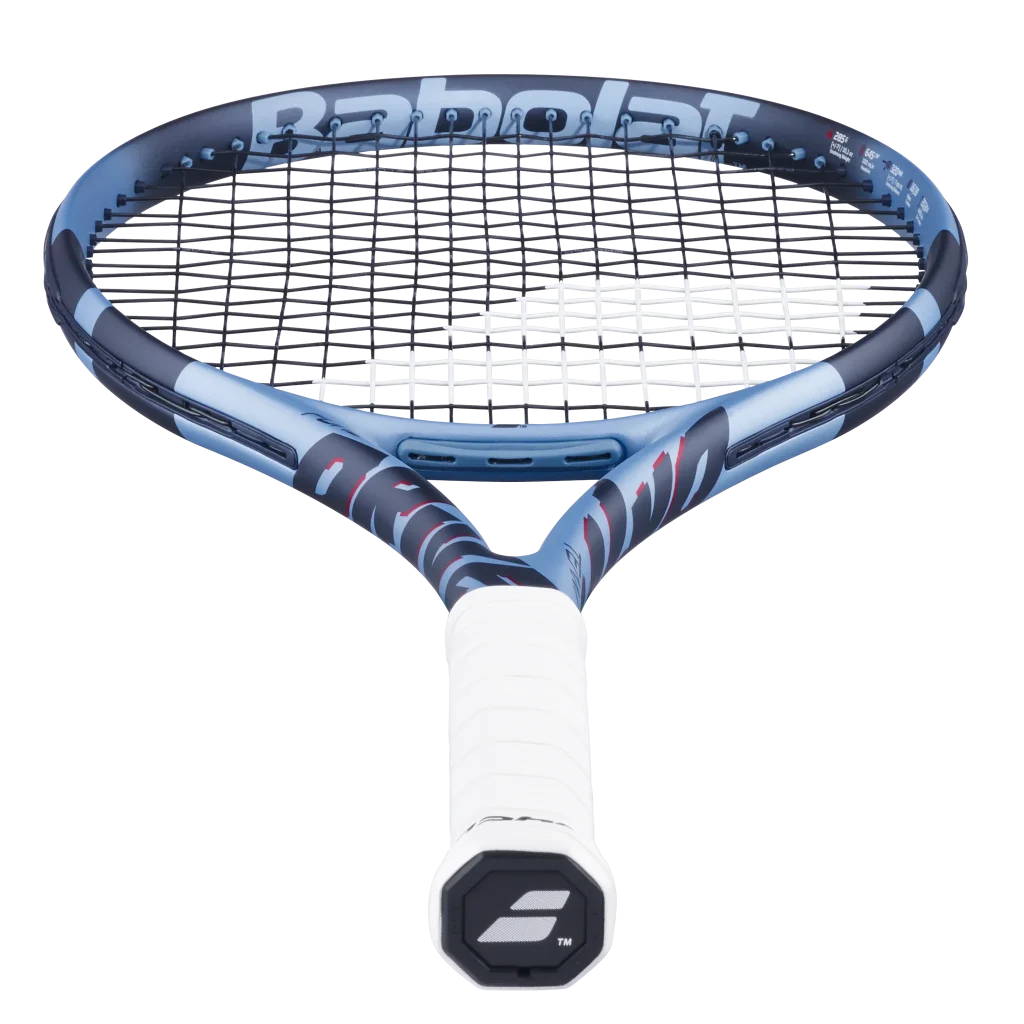

3. Babolat Pure Aero 100 2026 (Best for Spin)
Weight: 300g | Head Size: 100 sq in | String Pattern: 16×19
The Pure Aero line has been the spin-baseliner’s first choice for years, and the 9th-generation Pure Aero 100 2026 brings genuine performance improvements rather than just a cosmetic refresh. Babolat redesigned the throat geometry, which independent testing showed cuts air drag by around 6%, and the upgraded NF2 flax damping makes the frame more comfortable than previous Pure Aeros. For intermediate players who already swing fast and want to commit to a topspin-heavy game style, this is one of the most accessible spin-focused frames on the market.
Why It’s So Good
- Aerodynamic frame redesign produces measurable improvements in racquet head speed
- FSI Spin grommets allow strings to move freely for added snapback
- Manageable sub-325 swingweight keeps the racket fast and easy to whip
- Comfort-focused damping addresses one of the main historic Pure Aero complaints
Best for: Players developing a modern, topspin-driven baseline game who want to hit heavy, high-bouncing balls.
Potential drawbacks: Can feel overpowered on volleys and shorter swings; flat hitters may struggle to keep the ball in.

4. Yonex VCORE 100 2026 (Best for Aggressive Baseliners)
Weight: 300g | Head Size: 100 sq in | String Pattern: 16×19
The VCORE 100 2026 is the eighth-generation update to Yonex’s spin-and-power flagship, and it represents one of the more substantial reworks in the line’s history. Yonex has thickened the beam at the 3 and 9 o’clock positions for better torsional stability, thinned the tip for improved control, and slightly raised the average swingweight. The result is a noticeably more solid, more confidence-inspiring feel than the previous generation, with a stringbed that still produces serious spin and pace.
Why Many Players Love It
- New beam geometry significantly improves stability over the previous version
- Open 16×19 pattern combined with spin grommets generates heavy topspin
- Higher launch angle gives easy depth from the baseline
- Plush feel via Yonex’s VDM damping
Best for: Aggressive baseliners who want a racket that produces heavy, high-bouncing balls and rewards full swings.
Potential drawbacks: The high launch angle takes some adjustment, and flatter hitters may find the ball trajectory naturally wants to climb.

5. Wilson Clash 100 v3 (Most Arm-Friendly)
Weight: 295g | Head Size: 100 sq in | String Pattern: 16×19
For intermediate players dealing with tennis elbow, wrist issues, or general arm soreness, the Wilson Clash 100 v3 is genuinely in a class of its own. The frame’s stiffness rating of around 54 RA makes it one of the most flexible performance rackets on the market, well below the 65-72 RA typical of mainstream tweener frames. Wilson’s SI3D and Hit Stabilizer technologies allow the frame to flex horizontally for comfort whilst staying stable on contact, which used to be considered an impossible combination.
Why It’s Worth Considering
- Exceptionally low stiffness makes it ideal for players with arm sensitivity
- Stays surprisingly stable for such a flexible frame
- 16×19 pattern and easy acceleration support spin development
- Head-light balance makes it fast and easy to swing
Best for: Players prioritising comfort, those returning from injury, or anyone with chronic tennis elbow who still wants modern performance.
Potential drawbacks: The muted feel divides opinion; players who prefer a crisp, connected response may find it too damped. Power is moderate, so heavy hitters may want the Clash 100 Pro v3 instead.


6. Wilson Blade 100L v10 (Best for Control-Oriented Players)
Weight: 285g | Head Size: 100 sq in | String Pattern: 16×19
The Wilson Blade series has long been the choice of control-oriented players, and the Blade 100L v10 makes that legendary feel accessible to intermediate players in a lighter, more manageable package. The 10th-generation Blade introduces X-Loop geometry in the shoulders and StableFeel+ technology to improve stability without losing the connected response Blade players value. If you like to place shots precisely rather than hit them as hard as possible, this could be your perfect match.
What makes it special
- Signature Blade feel and feedback in a lighter, easier-to-swing frame
- 16×19 pattern offers good spin potential alongside the precision
- StableFeel+ keeps the frame steady on off-centre contact
- Tight factory tolerances mean very consistent specs frame-to-frame
Best for: Players developing touch and precision who want to grow into a more demanding control frame later.
Potential drawbacks: Less inherent power than the other options on this list; requires reasonable technique to hit through the court.


7. Head Speed MP 2026 (Best for All-Court Players)
Weight: 300g | Head Size: 100 sq in | String Pattern: 16×19
The Head Speed MP 2026 is the all-court alternative on this list, sitting between the pure spin frames and the control-focused Blade. Head has revamped the internals for 2026, introducing a new material called Hy-Bor (a boron-carbon fibre combination in the shaft) which improves stability and gives the frame a more connected feel through contact. Combined with a low 60 RA stiffness, the result is one of the more arm-friendly performance frames currently on the market, despite its 329 swingweight giving it real plough-through on bigger shots.
Why It Works So Well
- Genuinely versatile, with no real weaknesses across baseline, net, and serve
- Buttery 60 RA stiffness rating makes it kind to the arm
- 16×19 pattern delivers solid spin alongside controllable power
- Constant 23mm box beam gives a clean, classic feel
Best for: All-court players who like to mix up their game and want a racket that performs reliably across every shot rather than excelling in one specific area.
Potential drawbacks: Some testers reported a launchier feel than the previous generation, and the 2026 update has divided opinion among players who loved the older Speed MP’s specific characteristics.

How to Choose the Right Intermediate Tennis Racquet
Consider Your Playing Style
Baseline grinder. If you prefer staying back and hitting heavy groundstrokes, look for racquets with spin-friendly string patterns (16×19) and good launch angle. The Pure Aero 100 or VCORE 100 would suit you well.
All-court player. If you like mixing up your game with net approaches and variety shots, prioritise manoeuvrability and feel. The Speed MP 2026 and Blade 100L v10 are both strong picks here, with the Speed MP offering more power and the Blade leaning further into precision.
Power player. If you have a big swing and want easy depth, look for a racket that provides power without sacrificing too much control. The Pure Drive 2025 and Speed MP 2026 both fit this profile, though the Speed MP leans more toward versatility than raw power.
Arm-conscious player. If comfort is your priority, particularly if you’ve experienced tennis elbow or general arm fatigue, the Clash 100 v3 and Ezone 100 are the most arm-friendly options on this list.
Head Size Considerations
100-105 square inches is the sweet spot for intermediate players. This provides:
- Generous sweet spot for forgiveness
- Good power generation
- Enough precision for shot development
Avoid going larger unless you specifically struggle with consistent contact, as oversized heads can limit your development of precise shotmaking.
Weight and Balance
280-310g is ideal for most intermediate players. This weight range offers enough stability for consistent shots, a manageable swing weight, good power transfer, and comfort through longer sessions.
Even balance or slightly head-light works best for most intermediate players, providing manoeuvrability whilst maintaining stability.
String Pattern Impact
| Characteristic | 16×19 (Open Pattern) | 18×20 (Dense Pattern) |
|---|---|---|
| Spin potential | Higher | Lower |
| Power | Higher | Lower |
| Control | Lower | Higher |
| Precision | Lower | Higher |
| String durability | Lower | Higher |
| Best for | Generating pace and topspin | Developing touch and shot placement |
What About The Strings Themselves?
As an intermediate player, your string choice matters more than when you were a beginner, but you don’t need to overcomplicate things yet.
Recommended strings:
- Multifilament strings (like Wilson NXT or Tecnifibre X-One) for comfort and feel
- Synthetic gut for durability and consistent performance
- String tension: start in the middle of your racquet’s recommended range, typically 50-55 lbs
Avoid polyester strings until you’re hitting with more consistent power and spin. They can be harsh on the arm and don’t provide the feel feedback that helps intermediate players develop.
When to Upgrade Your Racquet
You’ll know it’s time to move to a more advanced racquet when:
- You consistently hit the sweet spot
- Your technique has become more refined
- You want more precision and are willing to sacrifice some forgiveness
- You’re playing competitive matches regularly
- Your current racquet feels too powerful or lacks control
This typically happens after 1-3 years of regular play, depending on your development speed and how often you play.
Maintenance Tips for Your New Racquet
String care
- Restring as many times per year as you play per week
- Don’t leave racquets in hot cars
- Clean strings after play to remove dirt and oils
Racquet care
- Use head protection tape to prevent frame damage
- Store in a racquet bag to protect from temperature extremes
- Check for cracks or damage regularly
- Keep the grip fresh, replacing it when it becomes slippery
Final Thoughts
Choosing the right intermediate tennis racquet is about finding the balance between forgiveness and performance that matches your current ability whilst providing room to grow. The racquets in this guide represent the best options available in 2026, each excelling in different areas to suit various playing styles and preferences.
Remember, the most expensive racquet isn’t necessarily the best for you. Consider your playing style, physical capabilities, and development goals when making your choice. If possible, try to demo racquets before purchasing. Many tennis shops and online retailers offer demo programmes that let you test before you commit.
The right racquet should feel like a natural extension of your arm, helping you execute the shots you want whilst providing feedback that helps you improve. Take your time with this decision, as the right intermediate racquet will be your partner in taking your tennis to the next level.
Whatever you choose from this list, you’ll be well-equipped to continue your tennis journey with confidence and style.


