


The Wilson US Open is one of the most recognisable tennis balls in the sport. It has been the official ball of the US Open since 1978, and over 70,000 of them are used during the tournament each year. That kind of pedigree creates high expectations, so how does it perform for the average club player picking up a tube from Amazon rather than a ball kid handing them over between games at Flushing Meadows?
I have been using Wilson US Open balls regularly across hard courts, artificial grass and indoor surfaces over the past couple of years. This review covers everything you need to know before buying, from on-court feel to durability and value for money.
Avoid leaving balls in your car boot or tennis bag for extended periods, especially in hot weather. Heat accelerates pressure loss and degrades the rubber core more quickly.
Quick Verdict
The Wilson US Open is a premium tennis ball that justifies its price tag for most players. It performs well straight from the tin with a lively, consistent bounce and holds its quality for longer than many competitors. Its main strength is hard court performance, where the extra duty felt really earns its keep. The only notable downside is that the felt can wear a little quicker than alternatives like the Head Tour on very abrasive surfaces, and they can feel heavy in damp conditions. For UK players on hard courts or indoor surfaces, these are among the best balls you can buy.
Rating: 9/10


What is in the Tin
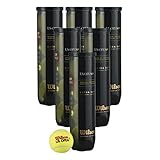
Wilson US Open balls come in standard pressurised tins of 3 or 4 balls, depending on the packaging you buy. The UK market typically sees the 3-ball tins, though 4-ball tins and bulk cases of 24 are also available through Amazon and retailers like Costco.
The balls are ITF and USTA approved for competitive play, so they are suitable for anything from your Saturday morning doubles to LTA-sanctioned league matches. They weigh approximately 57.3g each (the ITF standard sits between 56g and 59.4g) with a diameter of around 6.58cm.
Wilson offers the US Open in three variants:
- Extra Duty – designed for hard courts with thicker, more durable Tex/Tech felt. This is the version most UK players will want.
- Regular Duty – thinner felt suited to clay, grass and indoor courts. A good option if you primarily play on softer surfaces.
- High Altitude – a depressurised version for courts above roughly 1,000 metres elevation. Not particularly relevant for the UK unless you are playing tennis halfway up Ben Nevis.
Performance on Court
Bounce and Consistency
This is where the Wilson US Open really shines. Fresh from the tin, the bounce is lively and predictable. There is no awkward bedding-in period where the balls feel like rocks for the first few games, which is something you occasionally experience with cheaper options. They are ready to play from the first rally.
The consistency across a tube is also excellent. You will not find one ball bouncing noticeably higher or lower than the others, which speaks to Wilson’s quality control. Over the course of a match, the bounce gradually settles into a slightly lower trajectory as the felt opens up, but this happens at a predictable, even rate rather than a sudden cliff edge of performance.
Compared to the Dunlop Fort All Court, which is probably the most common ball you will encounter at UK clubs, the Wilson US Open feels crisper and maintains its bounce for longer. The Dunlop has a slightly softer, heavier feel that some players prefer, but it tends to die more quickly.
Spin
Spin generation is very good with these balls. The woven felt grips tennis strings effectively, and kick serves in particular benefit from the ball’s ability to hold rotation through the air. Sliced backhands also stay low and bite nicely on hard courts.
As the felt opens up after about 45 minutes of play, spin potential actually increases slightly before the ball starts to lose too much pressure. This is a characteristic shared by most premium balls, but the Wilson US Open handles this transition better than most, keeping the ball playable for longer before the felt becomes too fluffy to maintain consistent flight.
Power
Out of the tin, these balls are lively. Groundstrokes carry well through the court, and you will notice an immediate difference compared to budget options. The responsiveness is particularly noticeable on volleys, where the ball pings off the strings with satisfying precision.
One thing to watch is that the power level does taper off more noticeably than with some competitors. The Head Tour, for example, seems to maintain its zip for a slightly longer period. That said, when Wilson US Open balls lose their initial punch, they do not become unplayable. They simply transition from being a fast, aggressive ball to a more controllable one, which is actually quite pleasant to play with.
Control and Feel
The Wilson US Open offers an excellent balance between power and control. You do not feel like you are fighting the ball at any point, which is important for intermediate players developing their game and advanced players who rely on precise shot placement.
Touch shots around the net are a particular highlight. Drop shots and volleys feel clean and predictable, making these balls a pleasure to use in doubles where net play is more frequent. If you are looking for the best tennis ball machine balls for practising your volleys, these would be an excellent choice, though the cost per ball does add up quickly compared to pressureless alternatives.
Durability
This is the one area where the Wilson US Open receives mixed reviews from players, and it is worth being honest about it. On very abrasive hard court surfaces (particularly outdoor tarmac courts common in the UK), the felt can open up faster than you might expect from a premium ball. After about 90 minutes of competitive play on tarmac, the balls are noticeably fluffier and lighter in weight.
However, context matters here. On less abrasive surfaces like acrylic hard courts, artificial grass or indoor carpet, the durability is significantly better and you can comfortably get two or three good sessions from a single tube. The regular duty version performs well on clay and grass, though the thinner felt means it will not last as long as the extra duty on any surface.
For comparison, the Head Tour holds its felt together a little longer on abrasive surfaces, while the Dunlop Fort All Court deteriorates faster than both. In terms of pressure retention, Wilson US Open balls are among the best I have tested. Opened tins stored properly can still produce a decent hit two to three weeks later, which is impressive.
If you are playing three times a week on outdoor hard courts, you will likely go through a tube every couple of sessions. On indoor or softer surfaces, expect to get three to four quality sessions before they need replacing.
Surface Suitability
Hard Courts
This is the Wilson US Open’s natural habitat. The extra duty felt is specifically engineered for abrasive hard court surfaces, and it shows. Bounce is consistent, felt wear is manageable, and overall performance is excellent. If you primarily play on hard courts, this should be near the top of your list.
Artificial Grass and Astro
Good performance here too. The felt does not pick up sand excessively, and the balls maintain their characteristics well on these surfaces. The slightly firmer feel of the Wilson US Open works nicely on artificial grass, where softer balls can sometimes feel dead.
Indoor Courts
Excellent. The controlled environment means the balls last longer, and their lively characteristics are showcased perfectly without wind or moisture affecting play.
Clay and Grass
The regular duty version is better suited to these surfaces. On clay, the extra duty felt can pick up too much material and become heavy. On natural grass, the regular duty version provides sufficient durability without damaging the surface.
Damp Conditions
This is probably the Wilson US Open’s biggest weakness for UK players. In damp or wet conditions, these balls absorb moisture more readily than some alternatives and can become heavy and unresponsive. If you frequently play in questionable weather (and this is Britain, so that is most of us), you might want to keep a backup tube of a more moisture-resistant option.
How It Compares
vs Head Tour
The Head Tour is the Wilson US Open’s closest competitor at a similar price point. The Head Tour feels slightly softer with a marginally heavier, more controlled response. It holds its felt together a touch longer on abrasive courts. The Wilson US Open is livelier, more responsive out of the tin, and better suited to players who want a faster-feeling ball. Both are excellent. Your choice comes down to whether you prefer a firmer, more energetic ball (Wilson) or a softer, more controllable one (Head).
vs Dunlop Fort All Court
The Dunlop Fort is the UK’s most popular club ball, and with good reason. It is more affordable, widely available and plays well on all surfaces. However, the Wilson US Open outperforms it on durability and consistency. The Dunlop tends to die after about one match, whereas the Wilson keeps going. The Dunlop’s softer feel and lower price make it a solid choice for casual play, but for competitive matches or when you want the best possible performance, the Wilson wins.
vs Slazenger Wimbledon
The Slazenger Wimbledon is another UK favourite. It sits somewhere between the Dunlop Fort and Wilson US Open in terms of quality, with decent durability and a pleasant feel. The Wilson US Open offers more consistent bounce and better longevity, but the Slazenger is a perfectly respectable mid-range option.
vs Wilson Championship
If you are on a tighter budget, Wilson’s own Championship ball is worth considering. It uses Duraweave interlocking fibre technology to improve durability, but the overall feel and performance are a step below the US Open. Think of the Championship as the US Open’s reliable younger sibling. It will do the job, but without quite the same finesse.
Who Should Buy the Wilson US Open?
These balls are well suited to a wide range of players, but they are particularly good for:
Club players who take their tennis seriously. If you play regularly, enter league matches or tournaments, and care about the quality of ball you are hitting, these deliver at the level you would expect.
Hard court players. The extra duty version is specifically designed for this surface and performs at its best here. If most of your tennis is on hard courts, this should be near the top of your list.
Players who value consistency. The uniformity across balls within a tube and the predictable performance over time make these ideal for players who want to trust their equipment.
Doubles players. The responsive feel and clean touch at the net make these a favourite for doubles-focused players who spend time around the service line.
They are perhaps less ideal for players on a very tight budget (the Head Championship offers better value for casual play), or for those who exclusively play on clay or grass, where the regular duty version is less commonly stocked in the UK.
Value for Money
Wilson US Open balls typically retail for around £6-8 per tube of 4 in the UK, with bulk cases of 24 tins offering better per-ball pricing. Buying in cases can bring the cost per tube down noticeably, so if you know you will use them regularly, it is worth investing in a larger quantity.
At this price, they sit in the premium bracket alongside the Head Tour and above the Dunlop Fort All Court and Slazenger Wimbledon. Are they worth the premium? For competitive play, absolutely. For casual knockabouts, you could save money with a mid-range option without noticing a dramatic difference.
If you are going through multiple tubes per week, the Wilson Triniti is worth considering as an eco-friendly alternative with much longer lifespan, though the playing characteristics are different.
Storage Tips
To get the most from your Wilson US Open balls, keep unused tins in a cool, dry place at room temperature. Opened tins can be resealed (Wilson uses resealable lids) and will maintain reasonable pressure for a few weeks. If you want to extend the life of partially used balls further, tennis ball pressure cans are available that re-pressurise balls between sessions.
The Bottom Line
The Wilson US Open is a premium tennis ball that lives up to its prestigious name. It offers excellent bounce consistency, good spin potential, responsive feel and solid durability on hard courts. The main compromises are a slightly higher price than mid-range options and faster felt wear on very abrasive surfaces compared to the Head Tour.
For UK players on hard courts or indoor surfaces who want a reliable, high-quality ball for competitive play, the Wilson US Open is one of the best options available. It has earned its place as our top-rated ball in our complete guide to the best tennis balls, and after extensive testing, I would happily recommend it to any player looking to upgrade from budget alternatives.
Pair it with the right tennis shoes for your surface and a properly strung racket, and you have got yourself a setup that will serve you well for many matches to come.
Tennis Gear Guide provides honest, thorough equipment reviews to help UK players make informed purchasing decisions. Our assessments combine specification analysis, player feedback, and practical playing characteristics to deliver recommendations you can trust.
More Reviews From TGG

Acemate S10 Tennis Robot Review
I will admit something before we start. Before my first session with the Acemate S10,…

Wilson Defyer vs Blade
For a long time, the choice within Wilson’s range was simple for serious baseliners. You…

Defyer vs VCORE vs Aero
When I published my Wilson Defyer review, I promised a proper answer to the question…

Wilson Defyer Review
No racket in recent memory has been discussed as much before launch as this one,…

Head Extreme 2026 Review
Head has updated the Extreme for 2026, and on paper it looks like the most…

PUSUN PT-Max C Review
PUSUN has built a reputation for packing high-end ball machine features into prices that undercut…


